portfolio / notes / status-state-machine.mdoc
Your status is a state machine
From status strings to explicit business transitions. A booking's status starts as a label and ends up encoding who may change what, when, and what happens if two people try at once.
- TypeScript
- Architecture
- Domain modeling
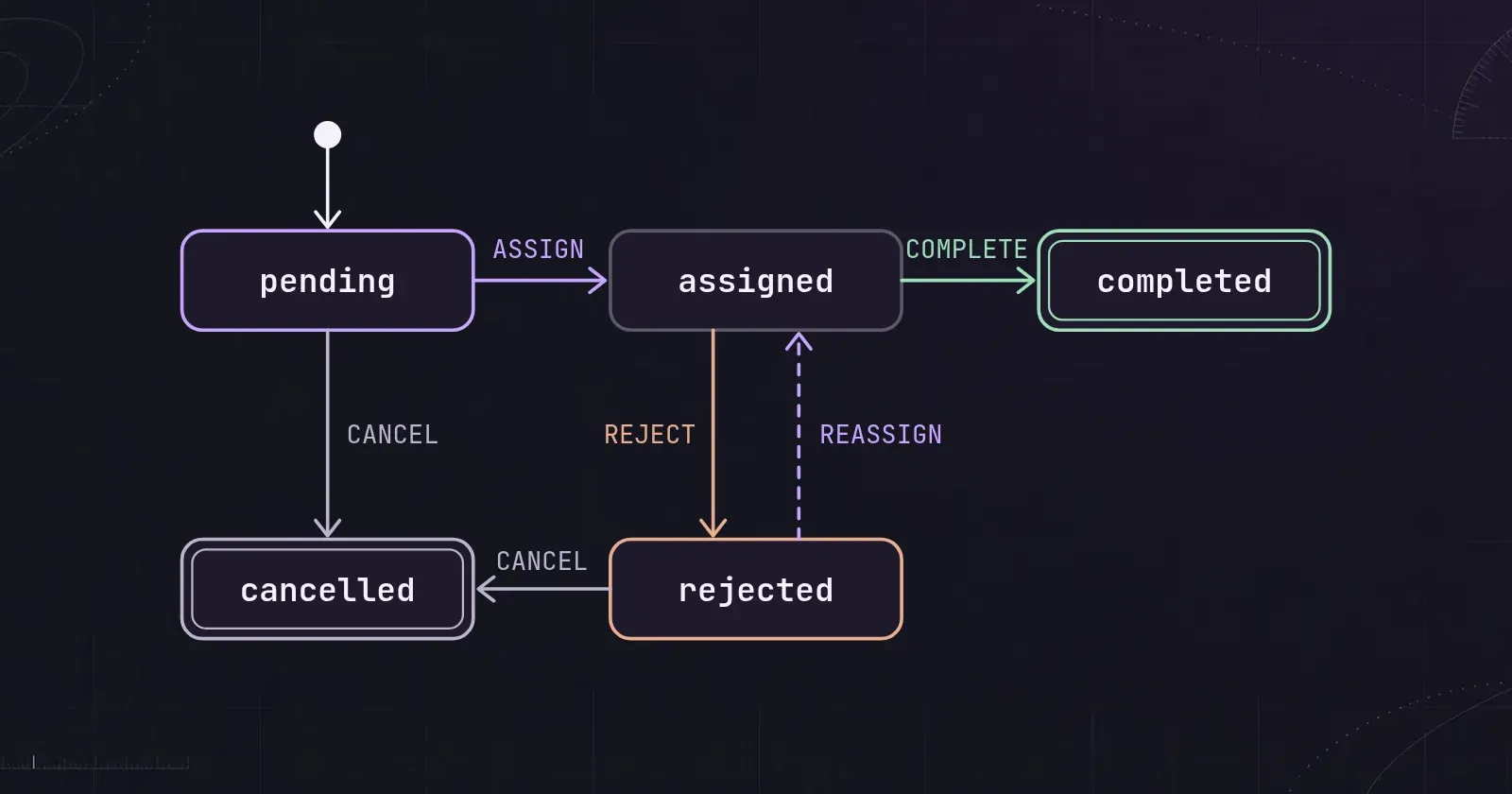
If we are talking about business apps, sooner or later we run into the famous status field. Take a booking: its status is the quickest way to know where it is in its life. Usually it starts in pending, moves to assigned and ends up in completed, although sometimes the provider rejects it (rejected) and we have to find another one, or it simply gets cancelled (cancelled). At first it is just a label the interface paints in a chip. Then the business adds a rule about when it may go from one state to another, then another, and one more, each in a different place. And one day a booking that was already completed shows up as rejected, and nobody can say which screen did it.
Fair warning, the title exaggerates a little on purpose. Not every status field needs a state-machine library, let alone a complicated automaton. But as soon as that status has rules about how it may change, those rules are already part of the business, and that is where I want to get to: the transitions deserve to be as explicit as the states themselves.
It starts with a string
Let's go back to the beginning. The first version of our booking usually looks something like this:
interface Booking {
  id: string;
  status: 'pending' | 'assigned' | 'rejected' | 'completed' | 'cancelled';
}

// Anywhere in the app:
booking.status = 'completed';
And for a while it works beautifully: the union type saves us from typos, the chip has its five colours and everybody is happy. What this code does not tell us is which status changes are allowed. Does it make sense for a booking that is already completed to go back to pending? Or for one the provider has just rejected to jump straight to completed? Not really, right? Well, that is the risk of the string: anyone holding a booking can give it whatever status they like, whether it is an admin screen, a background job or that endpoint someone wrote on a Friday afternoon to get out of a jam.
The first invalid transition
And then the rules arrive, as always, one at a time and without warning:
- You can only assign a booking to a provider who is free.
- Only an assigned booking gets completed (what gets completed is a service someone had).
- If the provider rejects it, we find another one or cancel it, and after three rejections, cancelling is all that is left.
- Completed or cancelled bookings are not touched again, and cancelling means telling the customer.
Notice that none of them talks about what a status is. They all talk about how you get from one to another, under which conditions and what happens next. And since our string has nowhere to keep any of that, the rules end up spread across buttons, endpoints and stray ifs, each with its own version of the story.
States are not enough
To talk about this without getting lost, it helps to give each piece a name:
- State: where the booking is now (
pending). - Event: something that asks for a change (
ASSIGN, with a provider). - Transition: the allowed move from one state to another when an event arrives.
- Guard: the condition that transition needs (the provider is free).
- Action: what happens as a result (tell the customer).
- Invariant: what must always be true (a completed booking has a provider).
With these pieces we can finally draw our booking's life:
Explicit transitions
And here is the same drawing as a table. Keep it handy, we will reuse it later as our test plan:
| From | Event | Guard | To |
|---|---|---|---|
| Pending | ASSIGN | The provider is free | Assigned |
| Pending | CANCEL | — | Cancelled |
| Assigned | COMPLETE | — | Completed |
| Assigned | REJECT | — | Rejected |
| Rejected | REASSIGN | The provider is free and there have been fewer than 3 attempts | Assigned |
| Rejected | CANCEL | — | Cancelled |
| Completed, Cancelled | any | — | Refused: final state |
In code, changing the status stops being a plain assignment and becomes a function: you pass it the current state and an event, and it gives you back the next state or tells you why it cannot happen.
type BookingState =
  | { status: 'pending' }
  | { status: 'assigned'; providerId: string; attempts: number }
  | { status: 'rejected'; attempts: number };
// ...completed and cancelled

type BookingEvent =
  | { type: 'ASSIGN'; providerId: string }
  | { type: 'REASSIGN'; providerId: string };
// ...REJECT, COMPLETE and CANCEL

const MAX_ATTEMPTS = 3;

// ok(state) or refuse(reason): the next state, or why it is refused
function transition(state: BookingState, event: BookingEvent, ctx: Context): Result {
  switch (state.status) {
    case 'pending':
      if (event.type === 'ASSIGN') {
        if (!ctx.isFree(event.providerId)) return refuse('provider-busy');
        return ok({ status: 'assigned', providerId: event.providerId, attempts: 1 });
      }
      // CANCEL → cancelled
      break;
    case 'assigned':
      // COMPLETE → completed, REJECT → rejected (no guards)
      break;
    case 'rejected':
      if (event.type === 'REASSIGN') {
        if (state.attempts >= MAX_ATTEMPTS) return refuse('too-many-attempts');
        if (!ctx.isFree(event.providerId)) return refuse('provider-busy');
        return ok({ status: 'assigned', providerId: event.providerId, attempts: state.attempts + 1 });
      }
      // CANCEL → cancelled
      break;
  }
  return refuse(`${event.type} is not allowed from ${state.status}`);
}
Notice that the states are objects ({ status: 'assigned', providerId, … }) and not plain strings. That is the beauty of the discriminated union: each state carries the data that only makes sense in it, so an assigned booking always has a provider and a rejected one always keeps count of its attempts. But careful, the types are not the rules. They do not know whether the provider is free, who may reject, or what happens when two requests arrive at once. That is the function's job, and the job of everything else we will see in this note.
Where the machine lives
The interface needs to know the machine too, to show only the buttons that make sense or to explain why "Complete" is disabled. But let's not be fooled: a check in the frontend improves the experience, it protects nothing. Another tab, an old client or a direct API call skips it without noticing.
The one really in charge is the server. The same transition (or its equivalent in the backend) runs where the change is saved, and the frontend's one is only a preview. And while we are at it, a piece of advice that saves trouble: do not mix business states with request states. rejected is something that happens to the booking; saving or request-failed is something that happens to one request from one screen. If they end up in the same field, one day a network error becomes a business decision.
When everything arrives at once
So far everything looks pretty tidy, a function decides and the server is in charge. But in real life requests do not queue up politely, they arrive at the same time, and that is where the story gets a little more complicated.
Picture this scene, which you have probably lived through. Two operators open the same booking, which is pending. Operator A assigns it to a provider and operator B, who has seen nothing, cancels it a second later. Both did the right thing with what was on their screen, and both transitions are valid from pending. Let's see what happens if the server simply reads, checks and writes:
| When | Operator A | Operator B |
|---|---|---|
| 0 s | Reads the booking: pending | |
| 1 s | Reads the booking: pending | |
| 2 s | ASSIGN is valid from pending: writes assigned | |
| 3 s | CANCEL is valid from pending: writes cancelled |
The result: the last one to write wins. The booking ends up cancelled, but the provider already has the notice and is on the way. And the funny thing is that nobody broke a rule: B checked a state that no longer existed by the time it wrote. Time passed between reading and writing, and in that gap someone else changed the booking.
The fix is to leave no gap: checking and writing must be a single step, and it must happen where the data lives. The most common way is to ask the database to update only if the booking is still exactly as we read it:
UPDATE bookings
SET status = 'assigned', provider_id = $2, version = version + 1
WHERE id = $1 AND status = 'pending' AND version = $3;
-- 0 rows updated: someone changed it first. Reload and decide again.
Let's read it slowly. The WHERE repeats the machine's condition (status = 'pending') and also looks at a version, a number that goes up with every change. If someone touched the booking between our read and our write, the version no longer matches, the UPDATE updates nothing and we find out. In the scene above, B would get "0 rows updated", reload, see it is already assigned and do something else, like talk to A instead of cancelling blindly.
This is called optimistic locking: we lock nothing while the user is thinking, we just check at the end whether someone got there first. The other option is a transaction that locks the row while the decision is made, and which one suits you depends on the system. But the idea underneath is the same: the state machine says which changes are legal, it does not stop two legal changes from colliding. That depends on how we save.
And then there are side effects, like emailing the customer when we cancel, which bring their own drama: our database and the email provider do not talk to each other, and either one can fail after the other has already done its part. The short version is to write the intent down together with the change (the outbox pattern) and make the notice safe to repeat, the same idempotency we asked for with payments in the mapping operators note. But that is worth a whole note of its own, so we will leave it for another day.
Test the transitions
Remember the table? Here it is, turned into tests. Every row is a case, and so is every row that is missing:
// Every row of the table (from + event → to) is accepted
it.each([
  ['pending', 'ASSIGN', 'assigned'],
  ['pending', 'CANCEL', 'cancelled'],
  ['assigned', 'COMPLETE', 'completed'],
  ['assigned', 'REJECT', 'rejected'],
  ['rejected', 'REASSIGN', 'assigned'],
  ['rejected', 'CANCEL', 'cancelled'],
])('%s + %s → %s', (from, event, to) => {
  expect(transition(state(from), ev(event), ctx)).toMatchObject({ ok: true, state: { status: to } });
});

// Final states refuse every event
it.each(['completed', 'cancelled'])('%s is final', (from) => {
  for (const event of ['ASSIGN', 'REJECT', 'REASSIGN', 'COMPLETE', 'CANCEL']) {
    expect(transition(state(from), ev(event), ctx).ok).toBe(false);
  }
});

// The attempts guard: after three rejections REASSIGN is refused and only CANCEL is left
it('a third rejection leaves only cancelling', () => {
  const tired = { status: 'rejected', attempts: 3 } as const;
  expect(transition(tired, ev('REASSIGN'), ctx)).toMatchObject({ ok: false, error: 'too-many-attempts' });
  expect(transition(tired, ev('CANCEL'), ctx).ok).toBe(true);
});
The negative cases matter as much as the positive ones, because they are exactly the rules that get broken by accident (look at the last test, which checks the limit on attempts). And once the states start piling up, property-based tests lend a hand: you generate random sequences of events and check that the invariants hold after each one.
In short
"How many times can a booking be rejected before we cancel it?" sounds like a product question, and it is. But as soon as someone answers "three", that answer becomes the condition on an arrow in the drawing, a guard in the function, a test and, if needed, a condition in an UPDATE. That is how our status field became a state machine: the day the business decided how it could change. And what works for me is writing those decisions down where the software can enforce them, and not in the memory of whoever was in that meeting: the transitions with their guards, one function that applies them, the server as the authority, and tests that also cover what must be refused.
And a confession: the states in this example did not come out right the first time, at least not ones that fit a real case. I had to go round a couple of times, asking myself what really happens in the business when a provider rejects a booking. That back and forth is not wasted time, it is exactly the work: each round polishes the rules, and with them the states and the transitions. In the end, a diagram the business can read and argue about is worth more than any library.
Check yourself
Pick an answer to see whether it is right, and why.
Sources: the TypeScript handbook on narrowing and discriminated unions; Statecharts, an introduction to state machines and statecharts; PostgreSQL's transaction isolation; and the XState docs, if you want to see how this is modelled with a library.